Friesland, Netherlands
Tucked away in the far north of the Netherlands, where the provinces of Friesland and Groningen quietly share a border, Lauwersmeer is a hidden gem that rewards kitesurfers willing to venture off the beaten track. This expansive man-made lake — born in 1969 when a closing dike sealed off the former Lauwers Sea from the Wadden Sea — offers a flat, sheltered stretch of inland water that looks promising for riders seeking a more forgiving environment than the open North Sea coast. Getting to Lauwersmeer takes a bit of planning. The nearest access points are reachable by car via the N361 from Groningen city or the N358 from the Frisian side. The village of Lauwersoog on the northern edge serves as the main hub, with a small harbour and parking facilities that make it a practical base. Load up your gear and follow the dyke roads — the landscape is flat and wide, and on a windy day you'll feel the breeze long before you see the water. Launching here calls for some patience and awareness. The lake's edges are lined with nature reserve zones, and birdwatching is a serious pursuit in the area — the Lauwersmeer National Park is home to thousands of migratory and nesting birds throughout the year. Riders should stick to designated access points and be mindful of restricted zones, particularly during spring nesting season. That said, when you find a clean strip of grass or sandy bank to launch from, the wide-open Dutch sky gives you all the room you need to set up safely. The water itself is where Lauwersmeer earns its appeal for kitesurfers. Being a sheltered inland lake, the chop is generally manageable — considerably less punishing than the North Sea — making it a spot that looks good for intermediates who want to build confidence or work on their technique without battling heavy swells. Wind tends to funnel across the flat polder landscape with few obstructions, and southwest to northwest winds are common across this part of the Netherlands, often delivering reliable sessions. That said, conditions can shift. The lake's relatively shallow depth means water can become choppy quickly in stronger gusts, and gusty inland thermals are possible on warmer days. Beginners should treat this as a spot that can be challenging when the wind picks up or changes direction unexpectedly. On the water, expect vast open space, striking skies, and the occasional heron or marsh harrier watching from the reeds — it's a uniquely peaceful kiting backdrop. The Lauwersmeer area isn't a dedicated kite park with schools and rental shops, so come self-sufficient. Bring your own gear, a repair kit, and a friend — having a buddy on the bank is always sensible at less-developed spots. The best window for kitesurfing here tends to be late spring through early autumn, when winds are consistent and temperatures are workable. Summer days can be long and light, which adds to the enjoyment. Check local forecasts and plan around the national park's seasonal restrictions to make the most of this quietly spectacular corner of the northern Netherlands.
Check the Breeza app for the current rideable window at Lauwersmeer.
Not globally ranked, but a kitesurf destination — a local favourite worth a check when the wind lines up.
Late spring through early autumn — roughly May to September — tends to offer the most pleasant combination of consistent wind and reasonable air temperatures. Summer brings long daylight hours, which is a bonus for extended sessions. Winter is possible but cold and can be harsh in the exposed northern Netherlands.
The flat, sheltered water makes it look promising for intermediates who want to practise without heavy sea swell. Beginners should be cautious, as gusty inland conditions can develop quickly and there are no kite schools or rescue services on site. Advanced riders will find it a relaxed, enjoyable session rather than a technically demanding spot.
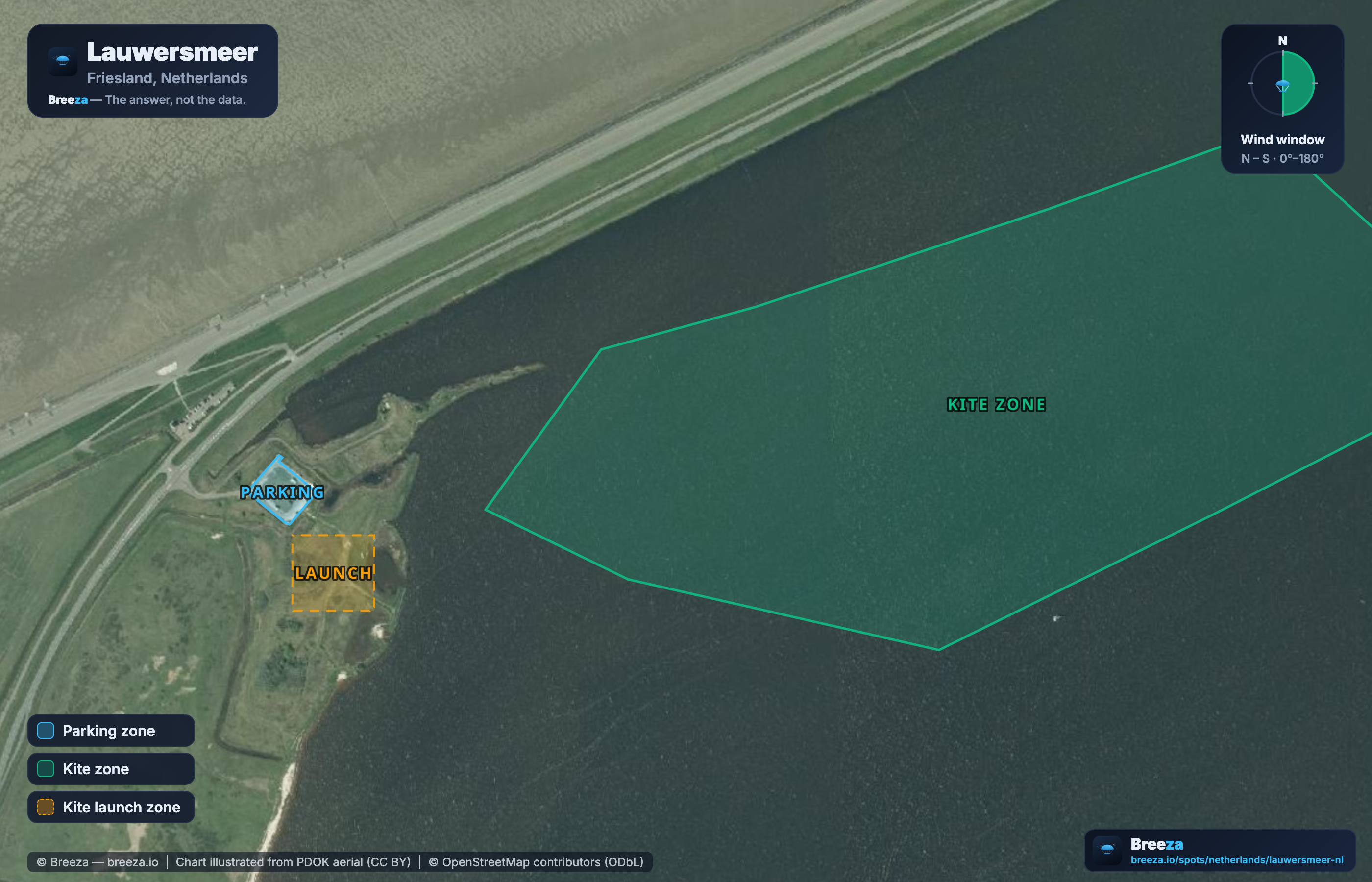
There are no purpose-built kite launch zones. Most riders access the water via the dyke roads and open banks around the lake, particularly near Lauwersoog harbour. Always check for birdwatching reserve boundaries and restricted nature zones before setting up, especially in spring and early summer.
The lake sits within a national park, so there are nature reserve zones that may be off-limits depending on the season. Shallow areas can produce unexpectedly choppy water in stronger winds. Wind can be gusty due to the flat polder landscape, and there are no on-site rescue services, so always ride with a buddy and stay within your ability level.
Wind in this part of the Netherlands is frequently in the 12–20 knot range, so a quiver covering roughly 9m to 12m tends to cover most days well. On lighter summer days you may want a larger kite in the 13–17m range. Bringing two kite sizes is always a good idea given the variability of inland wind.
Southwest to northwest winds are the most common across the northern Netherlands and tend to work well at Lauwersmeer, offering reasonably clean airflow across the flat landscape. Easterly winds can be lighter and more variable. Offshore directions relative to your launch point should always be assessed carefully before heading out.
Lauwersmeer is not a dedicated kite spot with rental shops or schools. The village of Lauwersoog has a harbour area with parking, and there are some local restaurants and accommodation options in the surrounding area. Come prepared with your own gear, food, and water.
By car is the most practical option. From Groningen city, take the N361 north toward Lauwersoog, which takes around 45 minutes. From the Frisian side, the N358 connects you to the lake area. Public transport options are limited in this rural corner of the Netherlands, so a car is strongly recommended if you're travelling with kite gear.
Yes. Lauwersmeer National Park covers much of the lake and surrounding land. It is particularly noted for birdwatching, with important migratory and nesting bird populations. Kitesurfers should respect designated nature zones, avoid disturbing wildlife, and check seasonal access restrictions before visiting.
It is not recommended. As an undeveloped spot without lifeguards, rescue boats, or on-site kite infrastructure, always bring at least one person to assist with launching and to keep watch from the bank. Self-rescue skills and a safety leash are essential.
Timing depends on local conditions. Check the Breeza app for the current rideable window at Lauwersmeer — it reads the live forecast against your gear and level.
Suitability depends heavily on the day's conditions. Breeza reads your level alongside the forecast and gives you an honest verdict — including when it's a no.
Wind direction is critical at Lauwersmeer — the right angle makes the difference between a great session and an unsafe one. Breeza cross-references live wind direction against the spot's safe window to tell you if today's direction is rideable for your kite.
Kite size at Lauwersmeer depends on the day's wind strength and your weight. Most kiters rig between 10m and 14m. Breeza calculates the ideal size for your gear, so you know before you leave whether it's a go.
Safety at Lauwersmeer depends on conditions and your experience. Check for offshore-wind days, local hazards and emergency contacts before you launch. Breeza gives a rideability verdict that includes a safety flag when conditions are borderline for your level.
See if Lauwersmeer is ridable right now — wind, direction, and a verdict for your gear.
Free · launching on iOS & Android
You've already got wind data — the hard part is knowing what it means for you. Most kiters end up checking two, three, four apps and still asking: can I actually go? Breeza was built by a kiter who had the same problem. Feed it your gear, weight and level and it tells you if Lauwersmeer is rideable right now. The answer, not the tabs.
Join the waitlist App coming soon — be first to know when Lauwersmeer is live.